
 By admin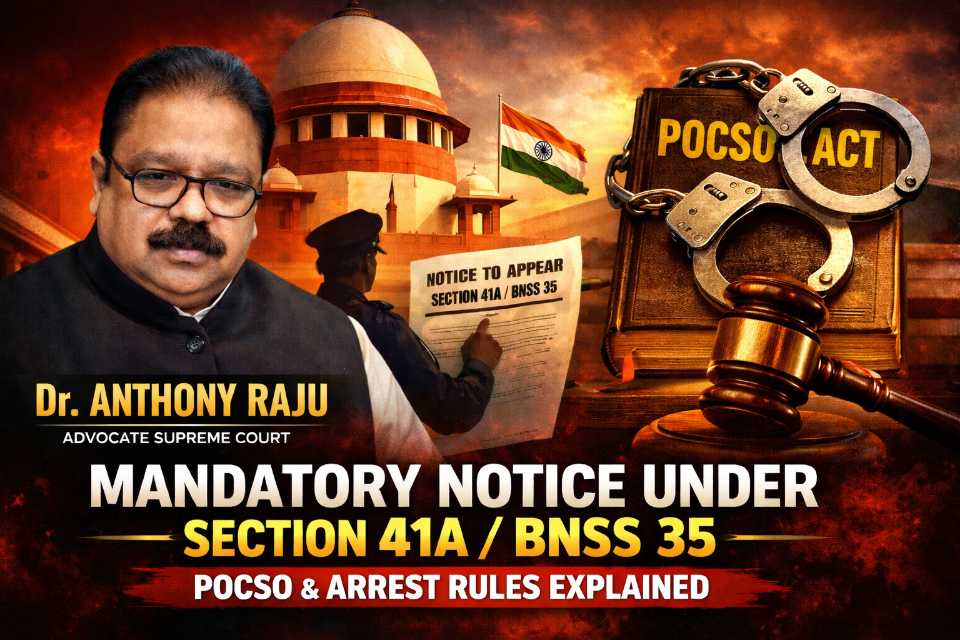
LEGAL NOTE
Why Notice Under Section 41A CrPC (Now Section 35 BNSS) Is Mandatory — Even in Sensitive Offences
By Dr. Anthony Raju
Advocate, Supreme Court of India | Expert in POCSO & Criminal Law
I. Introduction
The criminal justice system of India is governed not only by statutory provisions but also by constitutional morality and judicial discipline. One of the most significant safeguards against arbitrary arrest is Section 41A of the Code of Criminal Procedure, 1973, now reenacted as Section 35 of the Bharatiya Nagarik Suraksha Sanhita, 2023 (BNSS).
This provision embodies the spirit of Article 21 of the Constitution of India, ensuring that personal liberty is not sacrificed at the altar of mechanical policing.
II. Legislative Intent Behind Section 41A CrPC / Section 35 BNSS
The core objective is clear and unambiguous:
❖ To prevent unnecessary arrests
❖ To protect personal liberty
❖ To ensure fair investigation
❖ To reduce custodial abuse
❖ To align police action with constitutional safeguards
The law mandates notice of appearance instead of arrest where arrest is not imperative for investigation.
III. When Is Notice Mandatory?
Under Section 41A CrPC / Section 35 BNSS:
✔ Notice must be issued in offences:
Punishable with imprisonment up to seven years, and
Where arrest is not required under Section 41(1)
✔ Arrest can be made only if:
The accused fails to comply with the notice, or
There is a recorded and justified necessity (tampering, absconding, influencing witnesses, etc.)
👉 Non-issuance of notice where mandated invites judicial censure and may amount to contempt of court.
IV. Binding Nature of Judicial Guidelines
The Supreme Court has categorically held that:
Arrest is not mandatory merely because an offence is cognizable
Police must record written reasons justifying arrest
Magistrates must scrutinise compliance before authorising detention
Failure to follow these principles renders the arrest illegal and unconstitutional.
V. Application to POCSO Act (Especially Section 7) — A Nuanced Understanding
Offences under the Protection of Children from Sexual Offences (POCSO) Act are undoubtedly grave and sensitive. However, gravity alone does not nullify constitutional safeguards.
Legal Position
Some POCSO offences prescribe punishment up to seven years
Some prescribe punishment beyond seven years
There is no blanket exemption from Section 41A / Section 35 BNSS for POCSO cases
Key Legal Principles
✔ Automatic arrest is impermissible
✔ Police must demonstrate necessity of arrest
✔ Arrest must not be punitive or investigative shortcut
✔ Reasons for bypassing notice must be documented and defensible
Even in POCSO cases, the rule of law prevails over the rule of fear.
VI. Role of Courts and Magistrates
Magistrates are duty-bound to:
Verify whether Section 41A / Section 35 BNSS was complied with
Refuse remand where arrest is unjustified
Protect constitutional rights without compromising victim safety
Judicial oversight is the last constitutional shield against misuse of power.
VII. Consequences of Non-Compliance
Failure to issue notice where required may lead to:
❌ Illegal arrest
❌ Departmental action against police officers
❌ Adverse judicial remarks
❌ Grant of bail as a matter of right
❌ Violation of Article 21
VIII. Concluding Legal Opinion
Liberty is the rule; arrest is the exception.
Section 41A CrPC (now Section 35 BNSS) is not a procedural luxury but a constitutional mandate.
Even in POCSO matters, law enforcement must balance child protection with due process, not abandon one for the other.
Unnecessary arrest destroys lives; lawful investigation strengthens justice.
Professional Observation
This legal note is issued to promote constitutional policing, judicial accountability, and fair criminal process, without diluting the seriousness of offences or the rights of victims.
— Dr. Anthony Raju
Advocate, Supreme Court of India
Expert in POCSO & Criminal Defence Law
DISCLAIMER
This legal note is issued purely for academic, informational, and awareness purposes to explain the statutory scheme of Section 41A CrPC / Section 35 BNSS and its judicial interpretation, including its nuanced application in POCSO matters.
This note does not constitute legal advice for any specific case or fact situation.
The applicability of law depends upon the facts, circumstances, stage of investigation, and judicial interpretation prevailing at the relevant time.
Views expressed herein are based on existing statutes, constitutional principles, and judicial precedents, which are subject to change by legislation or subsequent court rulings.
Nothing contained in this note should be construed as diluting the seriousness of sexual offences or the rights and protection of victims, especially children under the POCSO Act.
Readers are strongly advised to consult a qualified legal professional before taking any decision or action based on this material.
The intent of this note is to uphold constitutional safeguards, rule of law, and fair procedure, while fully respecting the objectives of criminal law and victim protection.