
 By admin
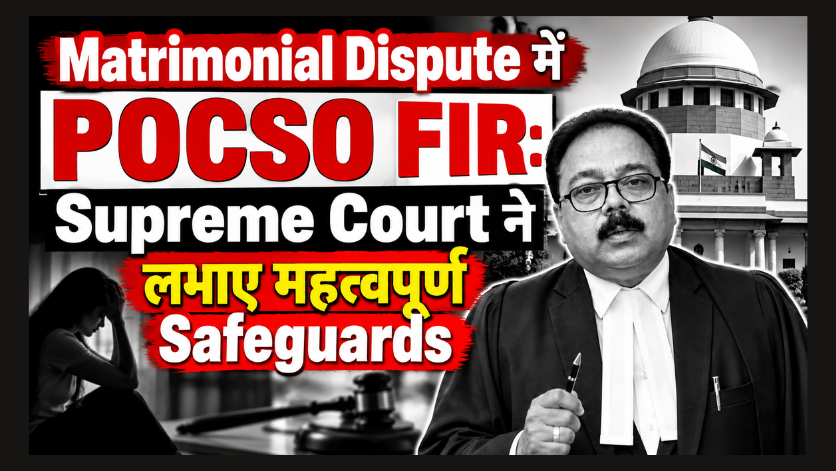
Supreme Court on POCSO Allegations Arising in Matrimonial Disputes: Key Safeguards
R v. E & Anr., 2026 INSC 1049
Legal Analysis & Insight by Dr. Anthony Raju, Advocate, Supreme Court of India
The Supreme Court, in R v. E & Anr., 2026 INSC 1049, has laid down important procedural safeguards concerning POCSO allegations arising in a particular category of matrimonial disputes.
The judgment is significant because it seeks to maintain a careful balance between the paramount objective of child protection under the POCSO Act and the requirement of a fair, objective and legally compliant investigation.
The safeguards, however, should not be understood as applying to every POCSO case. They operate in the specific circumstances identified by the Supreme Court.
The Threshold Conditions
The safeguards become relevant where:
- The allegation under the POCSO Act is against a parent of the child or a family member residing in the same household as the child; and
- There is a matrimonial dispute or strained relationship between the parents of the child.
Where these circumstances exist, the investigation requires heightened procedural care.
1. Registration of FIR Does Not Mean Automatic Arrest
One of the most important aspects of the ruling is that registration of a POCSO FIR does not, by itself, make arrest automatic.
The Investigating Officer must independently consider the statutory requirements governing arrest, including the framework under Section 35 of the BNSS.
The relevant question is therefore not merely whether an FIR has been registered, but whether the statutory conditions and necessity for arrest are actually satisfied and properly recorded.
This distinction is particularly important because an FIR sets the criminal law process in motion; it does not itself constitute proof of guilt.
2. Assistance of Child and Adolescent Mental-Health Experts
In the circumstances covered by the judgment, the Investigating Officer/SJPU is required to obtain appropriate assistance from an expert in Child and Adolescent Psychiatry or Clinical Psychology, through the prescribed institutional mechanism.
The purpose is to assist the investigation in understanding the relevant circumstances surrounding the child’s statements and allegations.
However, the Supreme Court has made an important distinction: an expert’s report is investigative assistance, not a determination of guilt or innocence.
It does not automatically bind the Investigating Officer and cannot, by itself, be treated as the sole basis for filing a chargesheet or a closure report.
3. Exceptional Circumstances
The requirement of expert involvement is not absolute in every conceivable situation.
Where the available material is sufficiently clear or “palpable” and the circumstances justify dispensing with expert evaluation, such evaluation may be omitted.
However, the Investigating Officer must record the reasons for taking such a course in writing.
4. Protection of the Child During Evaluation
The judgment also emphasises that investigation must not become a source of unnecessary pressure upon the child.
The evaluation should be conducted in accordance with law and professionally, while avoiding unnecessary or repeated questioning. Where applicable, appropriate support mechanisms may also be utilised.
Thus, child protection and fair investigation are complementary requirements, not competing objectives.
5. Private Complaints Before the Special Court
The Court has also addressed the situation where proceedings are initiated through a private complaint under Section 33 of the POCSO Act, rather than through a police FIR.
A complaint cannot simply result in mechanical issuance of summons. The Special Court is required to apply its judicial mind and consider whether sufficient prima facie grounds exist before proceeding further.
Accordingly:
Private Complaint ≠ Automatic Summons
6. POCSO FIR and Child Custody Proceedings
Another significant aspect concerns custody and guardianship disputes.
The mere registration of a POCSO FIR does not automatically determine or extinguish a parent’s custody or guardianship claim. The competent court must independently examine the available material and the circumstances of the case.
This is particularly relevant where criminal proceedings and family litigation are proceeding simultaneously.
7. Importance of Objective Evidence
The judgment demonstrates the importance of examining objective evidence rather than relying exclusively upon allegations.
In the case under consideration, investigation included examination of CCTV footage, statements, litigation chronology, psychological/psychiatric material and other surrounding circumstances.
Depending upon the facts of an individual case, relevant objective material may include:
- CCTV footage;
- mobile and electronic records;
- location data;
- school records;
- travel records;
- medical evidence;
- forensic evidence;
- DNA evidence, where relevant; and
- independent witnesses.
The proper approach is therefore to examine the complete evidentiary chronology, rather than treating an allegation in isolation.
Dr. Anthony Raju’s Legal Insight
In my view, the real significance of this judgment lies in its emphasis on procedural discipline without diluting the protective purpose of POCSO.
A POCSO allegation must be investigated with utmost seriousness. At the same time, the investigation must remain objective, evidence-based and consistent with statutory safeguards.
The judgment does not hold that matrimonial disputes make POCSO allegations unreliable, nor does it create a general exemption from arrest in POCSO cases.
Rather, where the specific circumstances identified by the Supreme Court exist, the authorities must exercise greater procedural caution and comply with the safeguards prescribed by law.
An FIR is the beginning of an investigation—not a judicial finding of guilt.
For the defence, the practical focus should therefore be on the complete chronology, objective evidence, statutory compliance, arrest requirements and the manner in which the investigation was conducted.
For investigating agencies and courts, the judgment reinforces the importance of ensuring that the child receives protection while the criminal process remains fair, independent and legally sustainable.
Conclusion
The Supreme Court’s approach may be understood through four fundamental principles:
CHILD PROTECTION
FAIR INVESTIGATION
STATUTORY COMPLIANCE
JUDICIAL APPLICATION OF MIND
The objective is not to weaken POCSO, but to ensure that its powerful protective framework operates through a process that is both effective and legally fair.
Dr. Anthony Raju
Advocate, Supreme Court of India
My team at the National Legal Aid Council is conducting extensive legal research on this subject, with the objective of examining POCSO law, child protection and procedural safeguards from a balanced legal perspective.
Legal Disclaimer
This article is intended solely for legal education and awareness. It does not constitute legal advice in any particular case. Every POCSO matter must be independently assessed on the basis of its FIR, statements, evidence, medical and forensic material, electronic evidence, procedural history and the complete investigation record.
POCSO Supreme Court Judgment 2026 · POCSO FIR Automatic Arrest · Section 35 BNSS · POCSO Matrimonial Dispute · POCSO Defence Safeguards
#POCSO #SupremeCourt #DrAnthonyRaju #POCSOAct #LegalAwareness