
 By admin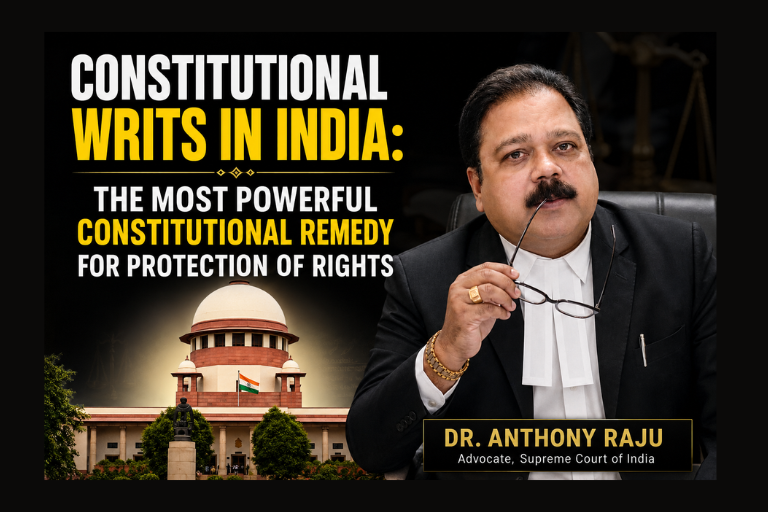
Constitutional Writs in India: The Most Powerful Constitutional Remedy for Protection of Rights
Understanding Articles 32 & 226 of the Constitution of India
Legal Analysis, Practical Examples & Legal Views by Dr. Anthony Raju, Advocate, Supreme Court of India
Introduction
The Constitution of India is not merely a document that grants rights to citizens—it also provides effective remedies for the enforcement of those rights. The framers of the Constitution realized that rights would be meaningless unless citizens had access to an independent judiciary capable of protecting them from arbitrary action by the State.
For this reason, the Constitution empowers the Supreme Court and the High Courts to issue Constitutional Writs, which are extraordinary judicial remedies designed to safeguard individual liberty, ensure governmental accountability, and uphold the Rule of Law.
Dr. B. R. Ambedkar famously described Article 32 as the “Heart and Soul of the Constitution”, emphasizing that constitutional remedies are the foundation of constitutional democracy.
What is a Writ?
A Writ is a formal written order issued by the Supreme Court or a High Court directing a person, authority, tribunal, government department, or public body to perform a legal duty, refrain from acting beyond its authority, produce a detained person before the Court, or justify the legality of holding a public office.
The Constitution recognizes five constitutional writs:
- Habeas Corpus
- Mandamus
- Prohibition
- Certiorari
- Quo Warranto
These writs serve as powerful constitutional tools against illegality, arbitrariness, abuse of power, and violations of Fundamental Rights.
Constitutional Provisions
Article 32
Article 32 empowers the Supreme Court to issue writs for the enforcement of Fundamental Rights.
Every citizen has a Fundamental Right to approach the Supreme Court whenever his or her Fundamental Rights are violated.
Article 226
Article 226 empowers every High Court to issue writs not only for the enforcement of Fundamental Rights but also for the enforcement of any other legal right.
Therefore, the jurisdiction of the High Court under Article 226 is much wider than that of the Supreme Court under Article 32.
The Five Constitutional Writs
1. Habeas Corpus
“You may have the body.”
Purpose
This writ protects personal liberty against unlawful detention.
Whenever a person is illegally arrested or detained, the Court may order the authority or individual detaining the person to produce him or her before the Court.
If the detention is found unlawful, immediate release may be ordered.
Practical Example
Suppose the police arrest an individual and keep him in custody for several days without producing him before the Magistrate or informing his family of the grounds of arrest.
The family may immediately approach the High Court or Supreme Court by filing a Habeas Corpus petition.
If the detention violates constitutional or statutory safeguards, the Court may direct the immediate production and release of the detainee.
Another Example
An adult woman is forcibly confined by her relatives to prevent her from marrying a person of her own choice.
Even though the detention is by private individuals, the High Court may issue Habeas Corpus to secure her liberty.
Dr. Anthony Raju’s Legal View
“Personal liberty is the most cherished constitutional value in a democratic society. Whenever liberty is unlawfully curtailed by the State or even by private individuals, Habeas Corpus becomes the Constitution’s quickest and most effective shield. No authority is above the Constitution, and no citizen should remain in illegal detention even for a single day.”
2. Mandamus
“We Command.”
Purpose
Mandamus compels a public authority to perform a legal or statutory duty which it has failed or refused to discharge.
The Court commands the authority to act according to law.
Practical Example
A retired government employee has fulfilled every legal requirement for pension, yet the department refuses to release the pension for several years without any lawful reason.
The High Court may issue Mandamus directing the department to process and release the pension.
Another Example
A Municipal Corporation deliberately refuses to grant a trade licence despite the applicant fulfilling every statutory requirement.
The Court may direct the authority to decide the application strictly in accordance with law.
Dr. Anthony Raju’s Legal View
“Public office is a constitutional trust. Government officials derive their powers from law and must exercise those powers fairly, transparently, and within a reasonable time. Mandamus reminds every public authority that public power exists to serve the people—not to inconvenience them.”
3. Prohibition
“To Forbid.”
Purpose
This writ prevents an inferior court or tribunal from proceeding with a case over which it has no jurisdiction.
It is preventive in nature.
Practical Example
A Consumer Commission begins hearing a dispute that legally falls within the exclusive jurisdiction of a Labour Court.
Before any final order is passed, the affected party approaches the High Court.
The High Court may prohibit further proceedings.
Easy Formula
Prohibition stops an illegal proceeding before the damage is done.
Dr. Anthony Raju’s Legal View
“Jurisdiction is the foundation of every judicial proceeding. Whenever a court or tribunal exceeds the authority granted by law, constitutional courts must intervene immediately to prevent injustice before it occurs.”
4. Certiorari
“To be informed.”
Purpose
Certiorari is issued after an inferior court or tribunal has already passed an illegal order.
The superior court may quash the order or transfer the matter to itself.
Practical Example
A government employee is dismissed from service without being given any notice or opportunity to defend himself.
The dismissal violates the principles of natural justice.
The High Court may quash the dismissal order through Certiorari.
Another Example
A Tribunal decides a matter over which it never had legal jurisdiction.
The High Court may set aside the entire proceedings.
Easy Formula
Certiorari corrects an illegal decision after it has been made.
Dr. Anthony Raju’s Legal View
“Justice cannot survive where decisions are rendered without jurisdiction or without observing the principles of natural justice. Certiorari protects the integrity of the justice delivery system by ensuring that legality prevails over arbitrariness.”
5. Quo Warranto
“By what authority?”
Purpose
This writ prevents unlawful occupation of a public office.
The Court asks:
“Under what legal authority do you hold this office?”
If the appointment is illegal, the Court may remove the person.
Practical Example
Suppose the law requires that the Chairperson of a statutory commission must possess at least twenty years of professional experience.
A person without the prescribed qualification is appointed because of political influence.
Any citizen—not necessarily personally affected—may challenge the appointment through Quo Warranto.
Another Example
A person continues to hold a constitutional office after becoming legally disqualified under the governing statute.
The Court may declare that the office has been unlawfully occupied.
Dr. Anthony Raju’s Legal View
“Public offices are public trusts. Constitutional and statutory appointments must always be governed by legality, merit, and transparency. Quo Warranto protects democratic institutions from unlawful appointments and strengthens public confidence in governance.”
Difference Between Prohibition and Certiorari
Prohibition
- Prevents an inferior court or tribunal from acting beyond jurisdiction.
- Issued before a final order is passed.
- Preventive in nature.
Certiorari
- Quashes an order already passed without jurisdiction or in violation of law.
- Issued after the order has been made.
- Corrective in nature.
Difference Between Articles 32 and 226
Article 32
- Supreme Court
- Only for enforcement of Fundamental Rights
- It is itself a Fundamental Right.
- Available throughout India.
Article 226
- High Courts
- For Fundamental Rights and all other legal rights.
- Wider jurisdiction.
- Exercised within territorial jurisdiction or where the cause of action arises.
Dr. Anthony Raju’s Legal Opinion on Constitutional Writs
“The power to issue constitutional writs is not merely a judicial power—it is a constitutional responsibility. Writ jurisdiction protects citizens against arbitrary arrests, illegal detention, abuse of executive authority, unlawful administrative action, jurisdictional errors by courts and tribunals, and illegal occupation of public offices. It reinforces the Rule of Law by ensuring that every authority, regardless of rank or office, remains accountable to the Constitution.”
He further observes:
“Rights without remedies are only promises. Constitutional writs transform those promises into enforceable guarantees. Every citizen should know these remedies because constitutional democracy survives only when courts remain accessible, independent, and fearless in protecting liberty and justice.”
Conclusion
The five constitutional writs represent the most effective judicial safeguards against misuse of public power. They protect personal liberty, enforce statutory duties, maintain judicial discipline, and preserve transparency in public administration.
Whether challenging an illegal arrest, compelling a government authority to perform its duty, restraining an inferior tribunal from exceeding jurisdiction, quashing an unlawful order, or questioning an illegal appointment to public office, writ jurisdiction remains one of the strongest pillars of constitutional governance in India.
An informed citizen is the strongest defender of constitutional democracy, and knowledge of writ remedies empowers every individual to seek justice through the constitutional courts whenever rights are threatened.
Disclaimer
This article is intended solely for educational, academic, constitutional, and legal awareness purposes. It does not constitute legal advice or create an advocate-client relationship. The availability, maintainability, and outcome of a writ petition depend upon the specific facts, applicable statutory provisions, constitutional principles, judicial precedents, and the discretion of the competent constitutional court. Individuals facing legal issues should seek professional advice from a qualified advocate before initiating legal proceedings.
Author’s Legal Views: The views expressed under the heading “Dr. Anthony Raju’s Legal Views” are presented as general constitutional opinions based on legal principles and are intended to encourage public understanding of constitutional remedies. They should not be construed as legal advice on any individual case.
Follow Dr. Anthony Raju
Dr. Anthony Raju
Advocate, Supreme Court of India
Managing Partner – Legal and Legal Associates (International Law Firm)
Chairman – All India Council of Human Rights, Liberties & Social Justice
#DrAnthonyRaju #AdvocateSupremeCourt #ConstitutionOfIndia #Article32 #Article226 #WritPetition #HabeasCorpus #Mandamus #Certiorari #Prohibition #QuoWarranto #FundamentalRights #RuleOfLaw #ConstitutionalLaw #JudicialReview #SupremeCourtOfIndia #HighCourt #LegalAwareness #IndianConstitution #HumanRights #CivilLiberties #LawStudents #Judiciary #LegalEducation #KnowYourRights #JusticeForAll #LegalReforms #PublicInterestLitigation #IndianLaw #ConstitutionalRemedies